In modern-day manufacturing, quality controls are more rigorous than ever, especially for high-mix/low-volume and medical molding cells. With the growing need for more complex designs and tighter control checks, manual inspections are simply falling behind.
For custom injection molders, this means that advanced inspection methods, robotic handling, and automated cells are becoming a standard practice in their field. These methods can detect irregularities in seconds, before the product even reaches the packaging process. So, how do smart automations help in-line quality control? Read on and let’s find out!
Which inspection systems catch defects that human eyes miss?
While manual sampling can be effective, human quality control is not infallible. With the growth of product variation, the rise of rapid part iteration, and defect tolerance approaching zero, automated inspection systems are becoming the most reliable solution.
Best of all, inline inspection systems can catch defects while the process is underway, with minimal delay. These technologies include:
2D vision systems
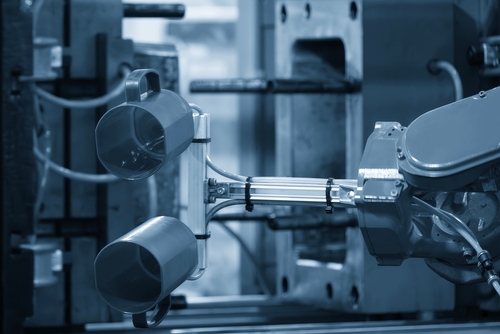
For detecting surface defects, injection molding plants use 2D vision cameras. This method can accurately detect streaks, burn marks, and other surface irregularities with area-scanning for stationary parts, and line-scan cameras for moving components.
On top of that, vision inspection software can check for thresholding, morphology, color, and other properties. Combined with AI models, this process can ensure high accuracy and low cycle times.
3D vision systems
Compared to 2D cameras, 3D vision systems go beyond the surface level. Technologies such as laser scanning, stereoscopic imaging, and structured illumination can generate accurate and detailed maps of each component. This makes them ideal for detecting warps, incomplete fills, and dimensional deviations that are nearly impossible to detect visually.
Laser metrology
Laser metrology can provide extremely accurate dimensional validation, often at micron-level precision. This technique is used to confirm critical properties such as wall thickness, diameters, concentricity, and other crucial features.
Thermal analysis
Thermal inspection systems can detect irregularities by analyzing the temperature distribution across the molded part. Infrared cameras can help detect internal voids, uneven cooling, and weak weld lines that can be difficult to detect visually. If left unchecked, these anomalies can lead to performance failures later on.
Acoustic/vibration analysis
Some defects pass visual detection entirely, and the only way to identify them is with acoustic and vibration analysis. Irregular vibration patterns can indicate internal cracks, inconsistencies, or faulty assembly. This method is commonly used as an extra layer of assurance, especially if visual inspection is insufficient.
Hybrid systems
Hybrid systems combine multiple methods into a single process, facilitating a more accurate and thorough quality check. Instead of relying on one method, manufacturers often combine visual scanning, thermal imaging, laser-based measurements, and acoustic tests. This enables:
- Higher accuracy for complex or high-variation components
- Lowered need for manual inspection and verification.
- Digital inspection records for traceability and regulatory compliance.
- Complete defect inspection for a wide range of criteria.
How to design an automated cell for contamination-sensitive parts?
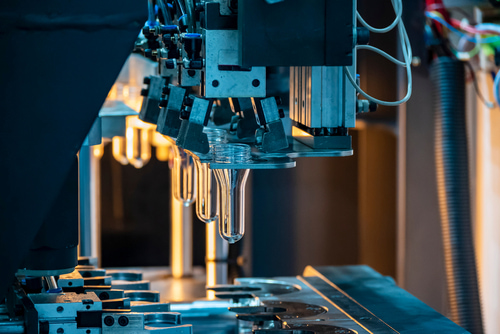
Smart automation plays a critical role in a variety of secondary processes beyond inspections. For contamination-sensitive components, automated systems allow for moving, inspecting, and processing parts without human contact and environmental exposure. In short, automated cells integrate smart in-line quality control methods to ensure consistent quality, full traceability, and regulatory compliance. This is done by:
- Utilizing automated part handling via robotics or pick-and-place systems
- Conducting inline inspection methods inside a sealed, controlled environment.
- Ensuring end-of-arm tools are smooth and easy to sanitize.
- Recording inspection results, process parameters, and other essential information.
Where to find one of the best custom injection molders?
At Wunder Mold, we combine 30+ years of expertise, the latest techniques, and state-of-the-art technology to design and produce molded components for multiple sectors. From following the latest rapid part iteration trends to ensuring consistent quality in each stage of the process, our team is qualified and equipped to develop the components your project needs in line with the highest industry standards. Whether you’re operating out of Sacramento Valley or anywhere else in the area, we deliver what we promise – fast turnaround, rigorously vetted products, and seamless delivery. Reach out today!