- Volume amplifies variation in ceramic molding processes
- Pilot runs must mirror full production conditions
- Verify shrinkage, tolerances, and geometry across batches
- Test strength, thermal behavior, and surface integrity
- Monitor tool wear, feedstock uniformity, and process stability
Moving from pilot runs to full production is where many manufacturing projects face their greatest risk. A design that performs well in limited quantities can behave differently once the same process repeats at higher volumes. Dimensional variation, tool wear, and thermal exposure become more visible as output increases.
For manufacturers relying on precision ceramic molding, early validation is what protects timelines, budgets, and long-term reliability. Scaling without structured testing can quietly introduce variation that was never apparent during development. Read on to understand what should be verified before committing to volume production. Keep reading to learn how early testing safeguards custom-engineered ceramic parts before scale-up.
Why is it important to test ceramic parts before mass production?
Testing before scaling matters because volume multiplies variation. During early runs, slight inconsistencies in shrink behavior or forming pressure may appear insignificant. As output increases, however, those same variations repeat cycle after cycle, gradually affecting dimensional stability and overall performance.
Shrinkage compounds over time. Tool wear begins to influence geometry more noticeably. Tolerance stacking becomes visible once components enter full assembly. What once looked like a stable process during a pilot phase can begin to drift subtly under sustained production conditions.
Before committing to volume, validation helps:
- Prevent large-scale scrap and rework
- Protect tooling investment from premature wear
- Confirm dimensional stability across multiple batches
- Reduce scheduling risk caused by unexpected variation
Scaling is not simply a matter of increasing quantity, it requires confirming that consistency holds under repetition.
What is the testing process in ceramic part manufacturing?
Validation follows a structured sequence designed to confirm stability at each stage of production. Rather than relying solely on final inspection, manufacturers evaluate forming, firing, and finishing conditions systematically.
Pilot runs
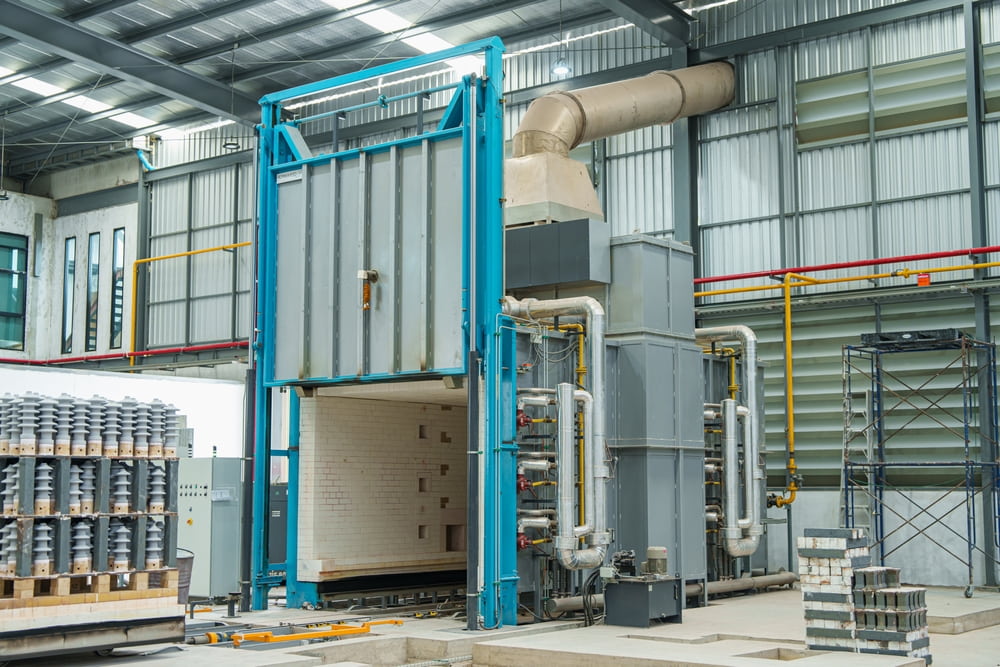
Pilot production is carried out using the same tooling, feedstock, and cycle parameters intended for full-scale output. These limited batches simulate real manufacturing conditions rather than producing isolated prototypes. The goal is to observe how the process behaves under repeatable, production-ready settings.
Dimensional verification
After firing, measurements are taken across multiple units to assess shrink consistency and tolerance retention. Evaluating several pieces rather than a single sample reveals whether dimensional trends remain stable or begin to shift. This step confirms that geometry aligns with design intent across the batch.
Mechanical validation
Structural performance must be confirmed under realistic service conditions. Strength testing, fracture resistance evaluation, and load behavior analysis ensure that performance observed during development remains consistent once the process is repeated.
Process confirmation
Thermal profiles, binder removal consistency, and environmental controls are reviewed carefully. Firing ramps, dwell times, and cooling rates must remain controlled to prevent internal stress or distortion. Confirming these parameters reduces the risk of gradual variation during extended production and provides clearer visibility into how tooling, processing, and finishing affect lead times. Together, these steps build confidence that the transition to volume will not introduce instability.
What should be tested before scaling to volume production?
Once the overall process framework is validated, attention shifts to specific performance categories. Testing should focus on variables most likely to shift as output increases.
Dimensional factors
Dimensional stability is foundational in keeping the production of ceramic parts repeatable. Even small changes in shrink behavior can influence critical tolerances.
Key checks include:
- Shrink variation across batches
- Stability of critical feature dimensions
- Flatness, concentricity, and alignment
- Warping or distortion after firing
Evaluating these elements across multiple runs confirms that geometry remains predictable.
Material performance
Whether you’re using zirconia or alumina for your ceramic parts, structural integrity must remain consistent under operational conditions.
Testing should examine:
- Strength under expected mechanical load
- Resistance to crack initiation and propagation
- Thermal expansion behavior
- Surface integrity following finishing operations
Performance validated in small trials must continue to represent full-scale output.
Production stability
Consistency across production variables determines whether volume output remains reliable.
Important areas to monitor include:
- Feedstock batch uniformity
- Tool wear tolerance over repeated cycles
- Inspection repeatability across shifts
- Stability of forming pressure and cycle timing
When these factors are controlled and verified, scaling becomes significantly less risky.
What are examples of manufacturing defects that can happen when scaling?
When validation is incomplete, scaling often reveals defects that were not visible during limited pilot runs. These issues typically emerge gradually as production cycles repeat and variation accumulates.
Several categories of defects tend to surface during volume increases:
- Cracking during firing: Internal stresses can intensify when heating and cooling cycles repeat at scale. Slight variations in density or temperature control may lead to microfractures that only become apparent after multiple runs.
- Warping and dimensional drift: Even small shifts in shrink behavior can produce gradual distortion. At higher volumes, these variations accumulate and begin affecting alignment and tolerance retention.
- Density inconsistencies: If material distribution varies between batches, structural strength may fluctuate. This can influence long-term durability under mechanical load.
- Surface irregularities: Higher throughput can expose finishing inconsistencies, resulting in texture variation or surface defects that were not visible during limited trials.
- Assembly misalignment: When dimensional deviation compounds across multiple components, tolerance stacking becomes more pronounced. Minor drift can create alignment challenges in integrated systems.
Who specializes in precision ceramic molding for industrial applications?
At Wunder-Mold, we understand that moving into high-volume output without thorough validation introduces unnecessary risk. Our team applies disciplined ceramic injection molding practices to evaluate forming conditions, firing control, dimensional stability, and long-term performance before production expands. By confirming process consistency early, we help manufacturers protect tooling investment, maintain repeatability, and avoid costly defects that only surface at scale.
If you’re preparing to increase output and want confidence that your process will hold under repetition, get in touch with us, and let’s validate your path to reliable volume production.